Philippines Culture
The soul of the Philippines
In philosophy, the word culture refers to what is different from nature, that is to say what is on the order of the acquired and not innate.
In sociology, culture is defined as "what is common to a group of individuals and as what ties them together". In its broadest sense, culture can now be regarded as the set of distinctive spiritual, material, intellectual and emotional features of a society or a social group. It includes not only the arts and literature, lifestyles and fundamental rights of human being, but also value systems, traditions and beliefs.
This "common pool" changes over time and by the forms of trade. It is a distinct ways of being, thinking, acting and communicate.
We often hear from tourists and expatriates: "Philippines? Oh, there is nothing to see, they have no culture".
Somehow we can understand. If you reduce culture to old buildings, old libraries and old paintings, then you should rather visit Rome, Paris or London to see old stones, papyrus fragments and walk all day through air-conditioned museums.
We also agree to the fact that discovering the Philippines' culture needs a lot of time. You cannot do it in one day, but it's exactly this slow approach, this looking for hints and traces that makes discovering the Philippine's culture so interesting.
Somehow the Philippines can be compared with the islands of Malta in the Mediterranean Sea. Both archipelagos have been situated on the intersection of multiple trade routes for thousands of years. In both groups of islands you can see, feel and live the remains of past invasions, the last intruder having usually left the still strongest evidence.
To start discovering the culture of the Philippines you only need to open your mind. Start by looking around, listen to the voices and ask questions.
Be curious!
You will be astonished of what you will learn!
The spoken language
The language is the primary key to any culture. The Philippines count over 90 distinct languages! Still lots of tales and legends are transmitted from grand parents to grand children in precious moments. Sometimes, someone writes them down. But most often they vanish with the family's memory.
On July 4, 1946, Tagálog (Pilipino) was officially declared the national language of the Philippines (wikang pambansâ ng Pilipinas). Candidates for the title of official language were the eight 'major' languages of the archipelago, having at least one million speakers.
In the final round were Cebuano, with the largest number of native speakers, and Tagalog, the language of Manila, the capital. Tagalog won, and from this day non-Tagalog first graders are required to learn Tagalog.
Tagalog is also a morphologically complex, predicate-initial language, in which the predicate (in many cases, a verb) occupies the initial slot of a sentence.
Tagalog, like its sister Philippine languages, is an Austronesian language distantly related to the languages of most of Indonesia, Madagascar, aboriginal Taiwan, most Pacific isles, and parts of New Guinea.
Magbasa nang higit pa tungkol sa mga wika na sinasalita sa Pilipinas.
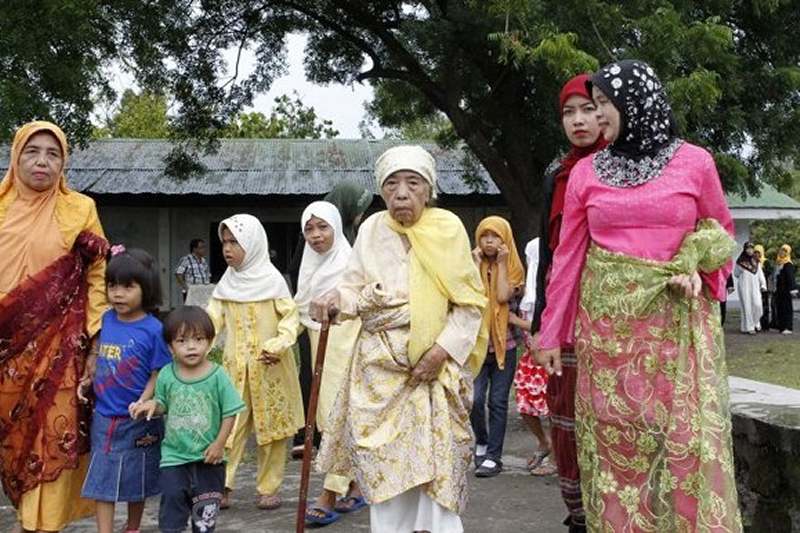
Often 3 or 4 generations live together
The written language
The written language is the next important key on accessing a culture. Remember the Rosetta Stone - the link which allowed understanding Egypt's hieroglyphs.
Unfortunately in most cultures the written word had only be accessible to the upper classes. As in Europe, literacy came very late to the farmers and workers in the Philippines. Today the literacy of the Philippine's population is 93.6%.
Lots of foreigners are happy that the Filipinos write in roman characters. This fact is the result of the Spanish colonialization. Before the Spaniards invaded the Philippines, people had their own writing. Read also "Literature".
More and more young Filipinos have a look back on their roots. 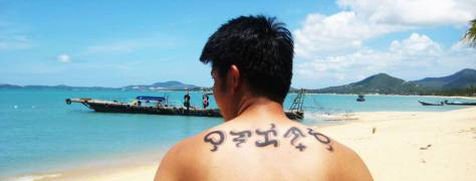
An interesting fact is the use of the ancient "Baybayin" writing as a security mark on the new Philippines banknotes. In the lower right corner, just above the value of the note, you find some strange signs.
When you hold the banknote against the light, the signs are completed by the back side equivalents and show the word Filipino written in Philippine ancient "Baybayin" alphabet.
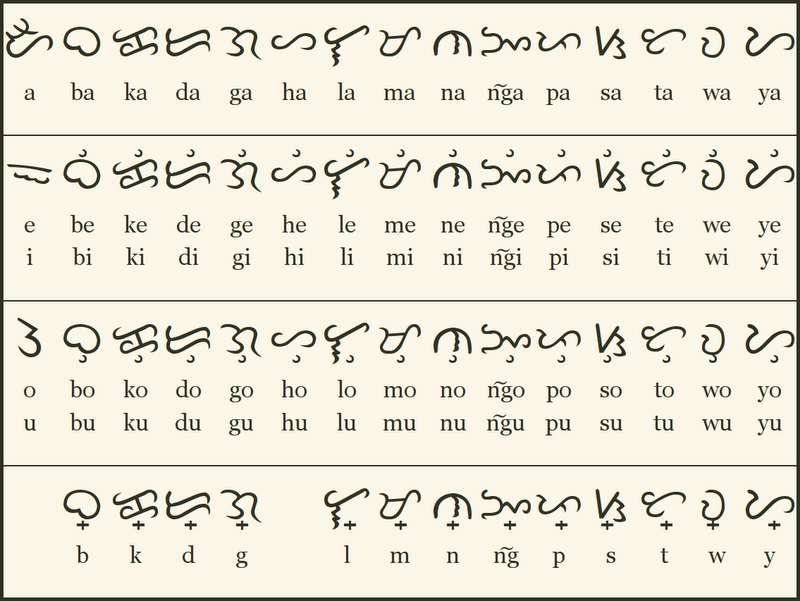
Magbasa nang higit pa tungkol sa pagsusulat sa Pilipinas.

Literature
The first book printed in the Philippines is the "Doctrina Christiana", see also the written language. It had been published 1593 in Manila.
Tomas Pinpin wrote and printed in 1610 "Librong Pagaaralan nang mga Tagalog nang Wikang Kastila", 119 pages designed to help fellow Filipinos to learn the Spanish language in a simple way. He is also credited with the first news publication made in the Philippines: "Successos Felices".
On December 1, 1846, La Esperanza, the first daily newspaper, was available in the country. Other early newspapers were La Estrella (1847), Diario de Manila (1848) and Boletin Oficial de Filipinas (1852).
In 1863, the Spanish government introduced a system of free public education that had an important effect on the ability of the population to read in Spanish and further in the rise of an educated class called the Ilustrado (meaning, well-informed).
Spanish became the social language of urban places and the true lingua franca of the archipelago. A good number of Spanish newspapers were published until the end of the 1940s, the most influential of them being El Renacimiento, printed in Manila by members of the Guerrero de Ermita family.
Magbasa nang higit pa tungkol sa panitikan sa Pilipinas.
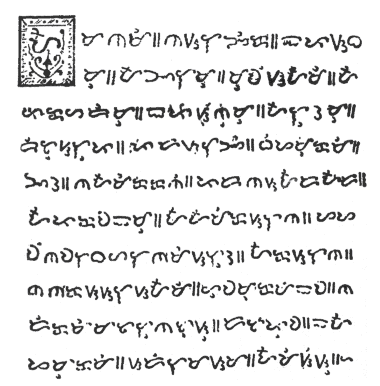
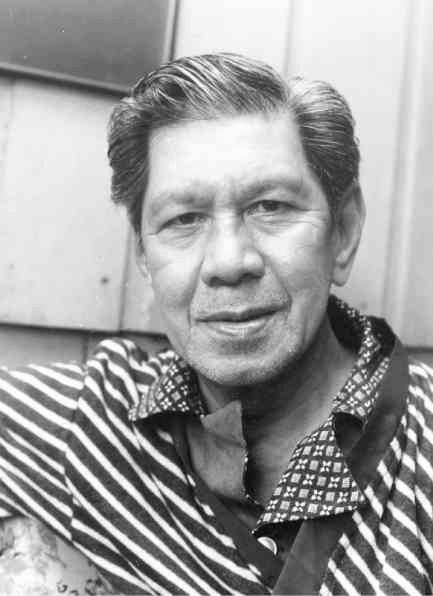
*Quijano de Manila is the pen name of Nick Joaquin, who is considered by many as the best writer in the Philippines today. In the following essay he displays his masterly style in prose.
Nick Joaquin was born in Paco on Calle Herran, as the son of Leocadio Y. Joaquin, a lawyer and a colonel of the Philippine Revolution, and Salome Marquez, a schoolteacher. Joaquin started to write short stories, poems, and essays in 1934. In 1961 the prize-novel "The Woman Who Had Two Navels" examined the pressures of the past upon the present. In 1976 Joaquin was declared a National Artist.
[Editor's note] Reading this essay changed my understanding of the people with whom I live. Many, for foreigners so strange behaviors, come into an other light when reading Nick Joaquin.
* * *
[Editor's note] In an earlier version of this page the whole text of this essay had been included directly into the page. This made the page long and heavy. We therefore have decided to present you a teaser only.
Those who are interested and can spare 10 minutes of reading time may click on the right hand button.
A Heritage of Smallness
The depressing fact in Philippine history is what seems to be our native aversion to the large venture, the big risk, the bold extensive enterprise. The pattern may have been set by the migration. We try to equate the odyssey of the migrating barangays with that of the Pilgrim, Father of America, but a glance of the map suffices to show the differences between the two ventures.
One was a voyage across an ocean into an unknown world; the other was a going to and from among neighboring islands. One was a blind leap into space; the other seems, in comparison, a mere crossing of rivers. The nature of the one required organization, a sustained effort, special skills, special tools, the building of large ships. The nature of the other is revealed by its vehicle, the barangay, which is a small rowboat, not a seafaring vessel designed for long distances on the avenues of the ocean.
However far we go back in our history it's the small we find--the nipa hut, the barangay, the petty kingship, the slight tillage, the tingi trade.
Music
Although, geographically, the Philippines belongs to the East, its music has been heavily influenced by the West owing to 333 years of Spanish rule and 45 years of American domination.
Music in the highland and lowland hamlets where indigenous culture continues to thrive has strong Asian elements. Spanish and American influences are highly evident in the music of the urban areas.
Three main roots are apparent:
- an old Asian influenced music referred to as the indigenous;
- a religious and secular music influenced by Spanish and European forms; and
- an American/European inspired classical, semi-classical, and popular music.
A system to classify Philippines' music is a geographic or ethno-linguistic approach: for example, traditional Tagalog music, which is somewhat more Hispanic in flavour, differs from Ifugao music and Islam influenced Maranao kulintang music.
In indigenous music, various kinds of instruments are made of bronze, bamboo or wood. These include gongs of various kinds of size and shapes, drums, flutes, zithers, lutes, clappers and buzzers.
Vocal genres include epics relating genealogies and exploits of heroes and gods; work songs related to planting, harvesting, fishing; ritual songs to drive away evil spirits or to invoke blessings from the good spirits; songs to celebrate festive occasions particularly marriage, birth, victory at war, or the settling of tribal disputes; mourning songs for the dead; courting songs; and children's game songs. It is this type of music that is still practiced today by the indigenous groups.

Kulintang - a row of small brass or bronze gongs
Dance
As varied are the people of the Philippines, so too are the dances. There are many dances performed in the Philippine Islands such as the popular "Tinikling", to the exoticized "Pangalay", to the skill-based interpretation of the "Banga" and Spanish-tinged "Jota"
Dances are performed anytime and anywhere. This starts in the morning in schools, where dance is an integrated part of education. It lasts till late in the night especially when there is a fiesta.
Dancing is deep inside Filipinos. "Dancing keeps us away from negative things, when you move, everything is positive, there’s no right or wrong, you release all your emotions and it will end up with a beautiful smile."
The Philippines have many popular folk dances which have evolved and changed as they have been passed down from generation to generation. Although a particular dance might be performed slightly differently from one region to the next, its remains true to its roots.
Dancing plays an important role in Filipino culture, telling their history and preserving traditions through folk dances and music. These dances are entertaining to observe, and even more fun to learn and perform yourself.

A dancer at the Lanzones festival in Camiguin
Movie
In August 1897, Liebman and Peritz, two Swiss entrepreneurs, presented the first imported movies on the Lumiere Cinematograph in Manila at Escolta Street.
Using the Lumiere Cinematograph as a camera, Antonio Ramos locally filmed Panorama de Manila (Manila landscape), Fiesta de Quiapo (Quiapo Fiesta), Puente de España (Bridge of Spain) and Escenas Callejeras (Street scenes), making him the first movie producer in the Philippines.
After the second world war, a resurgence of Visayan films came about through Lapu-Lapu Pictures. The 1950s were labeled as the first golden age of Philippine cinema. Four big production studios (LVN Pictures, Sampaguita Pictures, Premiere Productions and Lebran International) were at their peak in filmmaking.
The 1970s were the second golden age of Philippine cinema with the period of the avant-garde filmmakers.
In 1977, Kidlat Tahimik, made a film entitled Mababangong Bangungot (Perfumed Nightmare), which won the International Critic’s Prize in the Berlin Film Festival that same year.
The year 2009 brought the highest international esteem to a Filipino filmmaker when Brillante Mendoza was judged as the Best Director at the Cannes Film Festival for his film Kinatay (Butchered), a movie about murder and police brutality.
Today 9 out of 10 movies are "Bollywood" style

But the one film out of ten is a piece of art. It's not always accepted by the average movie goers, but it stands out of the mass production of Mumbay and Hollywood inspired productions. The Cannes Film Festival proves that Pinoy movies can be outstanding.
And more astonishing is the fact that Jaclyn Jose could step out of this mass production. During many years I saw her in these cheap all day soap operas on GMA and ABS-CBN. These most awful TV channels that shower you all day with cheap productions and much more advertisement. Did I really see her? No I just caught a glimpse at her, when I passed by one of this millions of TV sets installed everywhere.
Cannes Film Festival 2016
Best actress: Jaclyn Jose
in "Ma' Rosa"
The Cannes Film Festival is one of the 3 most important film festivals in Europe aside Venice and Berlin. A "Palme d'Or" in Cannes is culturally much more worth than an "Oscar" in Hollywood. The Oscar is just another promotion tool to see $$$.
Theatre
Theatre arts have long been existing as a part of the Filipino tradition and serve effectively as a medium of social awareness and entertainment. It is also a means of liberal and artful way of expressing opinions and talents.
As part of the Philippine tradition, many festivals and occasions are celebrated in the country where theatre arts are in use. For instance, during Holy Week, "Cenaculo" takes place as an on-stage performance that re-enacts the passion of Christ. Another is the Moro-Moro which expresses the conflict between Christians and Muslims in the country.
In other towns, a famous theatre form called carillo, which is usually a drama play, is shown after the harvest season. "Zarzuela" is another famous theatre performance, a local version of Spanish operetta. In many other places or occasions, variety of traditional plays that express the Filipino love for arts are shown even up to this very day.
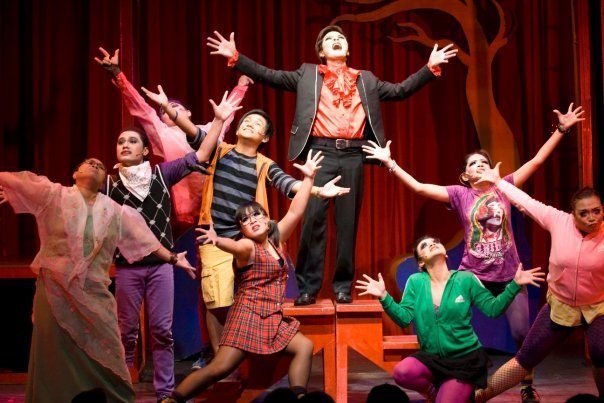
PETA - Philippine Educational Theater Association

The Philippine Madrigal Singers
Painting
The first paintings were commissionned works during the Spanish colonial era. Since most art produced during the first two centuries of Spanish occupation were for the church, the friars enforced strict supervision over their production. Until the 19th century, art was only for the church and religious use.
There is also some Chinese influence which can be found in the brush handling.
Tagalog painters Jose Loden, Tomas Nazario and Miguel de los Reyes, did the first still life paintings in the country. They were commissioned in 1786 by a Spanish botanist to paint the flora and fauna found in the country.
Secular subject matter in painting only increased during the 19th century. With more tourists, ilustrados and foreigners demanding souvenirs and decorations from the country, tipos del pais developed in painting. These watercolor paintings show the different types of inhabitants in the Philippines in their different native costumes that show their social status and occupation. It also became an album of different native costumes. Damian Domingo y Gabor (ca. 1790-1832) was the most popular artist who worked in this style.
Several Filipino painters had the chance to study and work abroad. Among them were Juan Novicio Luna and Felix Resureccion Hidalgo who became the first international Filipino artists when they won the gold and silver medals in the 1884 Madrid Exposition.
During the American period (1900-45) on-demand portraitists included Fabian de la Rosa, Miguel Zaragoza, Teodoro Buenaventura, Jorge Pineda and above all, Fernando Amorsolo, whose style would dominate the period.
Amorsolo designed the logo for Ginebra San Miguel (Markang Demonyo) depicting St. Michael vanquishing the devil. The logo is still in use in its original form today. The owner of the beverage company, Don Enrique Zobel, who is an ardent patron of the arts, was so impressed by his work that he offered to send Amorsolo to the Academia de San Fernando in Madrid for further studies with a generous stipend for himself and his family.
Despite his exposure to Western influences, Fernando Amorsolo retained his Filipino consciousness. He was drawn more towards the gentle rolling hills and rice fields of the Philippines rather than the cosmopolitan world of Europe's proud cities. Even his illustrations of Spanish women were drawn with slender physiques, narrower hips, and smaller breasts more typical of Filipinas rather than full bodied Caucasian women. One of his most copied paintings is the "Palay Maiden".
Fernando Amorsolo's work still influences many contemporary painters. One of them is Monico Benjamin Botor. Botor was born in Naga City, Camarines Sur and now lives in Bagasbas near Daet. He is a hobby painter who recently started taking it seriously as an avenue of expressing his innate talent to explore in the aesthetic realm one's quest to capture the appeal of nature and human response to its illusive beauty and profound mystery.
Deeply rooted in culture, he pays homage to the Filipino tradition and way of life. He uses his artistic insight and experience to capture the color and essence of a Philippine setting.
If you compare Amorsolo's painting below with the painting in Botor's atelier, then you find a girl in a very similar pose in the water.

Another contemporary artist I know is Valentino Goyenechea Jr. He lives with his family in Dumaguete (Negros). Goyenechea is a visual artist in different domains such as painting and photography. Two of his paintings decorate our house.
This article contains excerpts of Ronnie Pasigui's presentation. Another very interesting website is Go Philippines, a blog dedicated to all Filipinos, locals, OFW, migrants and tourists to gain more knowledge about Philippines.

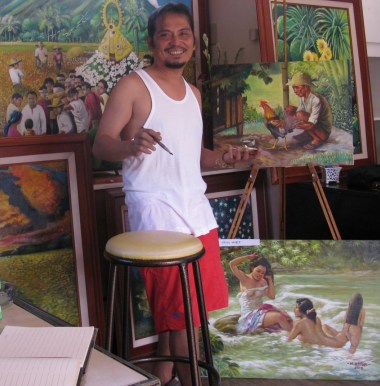
Monico Benjamin Botor
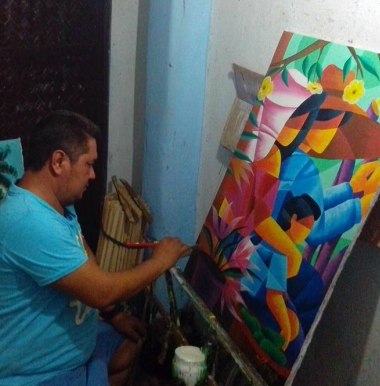
Valentino Goyenechea Jr.
Sculpture
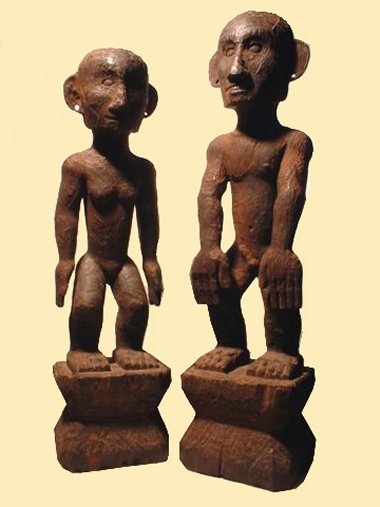
Early carved human figurine are known from the cordilleras. Still today, the bulols, or "Ifugao rice Gods," are kept in the house or granary, and are usually made in pairs. They are carved of narra wood, which represents wealth, happiness, and well-being. Every step in their production requires a ceremony, from tree selection to arrival at the owner's house. A consecrated bulol has been bathed in pig's blood, had myths recited to it, and received offerings of wine, ritual boxes, and rice cakes.
The carvings brought to the Philippines by early Arab and Russian missionaries were of beveled type as the slanting type called Okkil. Although the word literally means XXX it is not confined to carving alone but also refers to design.
A familiar example of sculpture with the integration of architecture is the Art Deco Style of the Metropolitan Theater at Liwasang Bonifacio completed by Juan Arellano in 1931.
Woodcarving comes in ornamental form in the houses of the Maranao like that of the "torogan" which features the "panolong", an extended beam carved with the Sarimanok or the Naga design.
Napoleon V. Abueva is known as the "Father of Modern Philippine Sculpture". He was born in Tagbilaran, Bohol in 1930. In 1951, he won the Pura Villanueva-Kalaw scholarship and finished Bachelor of Arts in Sculpture in University of the Philippines in 1953.
Abueva utilized almost all kinds of materials from hard wood (molave, acacia, langka wood, ipil, kamagong, palm wood and bamboo) to adobe, metal, stainless steel, cement, marble, bronze, iron, alabaster, coral and brass.
Among the major works of Abueva are: Kaganapan (1953), Kiss of Judas (1955), The Transfiguration at the Eternal Garden Memorial Park (1979), Fredesvinda in Fort Canning, Nine Muses at the UP Faculty Center (1994), Sunburst at the Peninsula Manila Hotel (1994) and the bronze figure of Teodoro M. Kalaw in front of National Library.
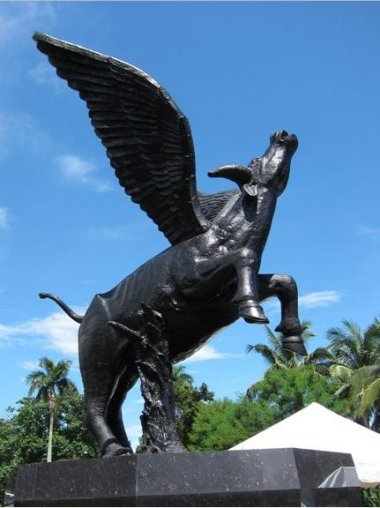
The Pegaraw pegasus and tamaraw by Napoleon V. Abueva
Handicraft
Inspired by the Japanese One Village One Product Movement of 1979, the Philippines' OTOP program was proposed by then-President Gloria Macapagal-Arroyo as early as 2002 and launched in 2004. Current Filipino President Benigno 'Noynoy" Aquino has authorized the continuation of the OTOP program.

You find this logo in our Explore section, where we show you cities and islands.
OTOP products vary, and can include fruits, specialty dishes, or handmade products. Examples of OTOP products include Arabica coffee in the Cordillera region, cacao products in San Isidro in Davao del Norte, and brooms in Santa Fe in Nueva Vizcaya.
Other OTOP products are the Lanzones fruits and the famous Pastel buns in Camiguin. The Bicol Express in Naga-City isn't a train but a spicy food. Another good example is the potter's village of Lezo in Aklan, Panay.
Handicraft you can see anytime and anywhere in the Philippines. On nearly any island you find a black-smith who makes the traditional bolos. Fishermen wear the typical conic hat made of sliced bamboo or palm leaves.
Hand made items are usually not expensive, are decorative and make the perfect gift (pasalubong) for your family and your friends.
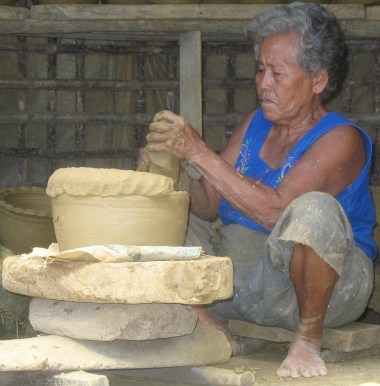
Bahala na !
Bahala Na translates literally as "leave it up to God (Bathala)" and it is used as an expression, almost universally, in Filipino culture.
Elma L. Chong has collected "100 reasons to be happy to be a Filipino". When you read them, you understand why Filipinos are nearly always smiling.
* * *
[Editor's note] In an earlier version of this page the whole text of this essay had been included directly into the page. This made the page long and heavy. We therefore have decided to present you a teaser only.
Those who want to laugh and can spare 10 minutes of reading time may click on the button. You won't regret.
This photo is the almost perfect illustration of Bahala na!